
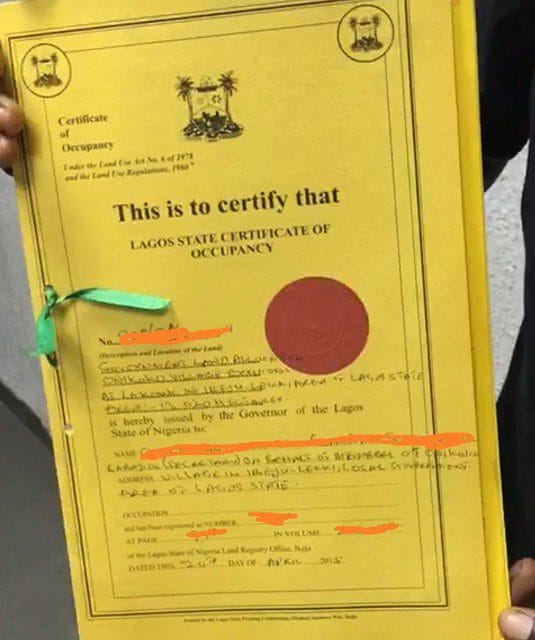

Here’s the uncomfortable truth: you can’t spot a forged Certificate of Occupancy (C of O) or survey plan just by looking at it. Good fakes look perfect. The only reliable test is to check the document against the government’s own records. Take the C of O number to the Lands Bureau/Land Registry and have them print their copy to compare names, survey number and land size. Take the survey plan to the Surveyor-General’s office to confirm it’s genuine and get the land “charted” — checking whether it falls under government acquisition. Use your own surveyor and lawyer, never the seller’s. If details don’t match the registry, walk away.
Here’s the hard truth about document fraud in Nigeria: the paper always looks good. Fraudsters print beautiful Certificates of Occupancy, complete with stamps, seals and official-looking signatures. Some don’t even bother forging from scratch — they just edit a real one. So “it looks legit” tells you nothing. What tells you everything is whether the government’s records agree with the paper in your hand. Let’s walk through exactly how to check.
Why you can’t spot a fake by eye
A survey plan is like a car’s paint job; a title search is checking who really owns the car. You can admire the paint all day and still be buying a stolen vehicle. Forgers know buyers judge documents by appearance, so they perfect the appearance. The defence isn’t a sharper eye — it’s going to the source.
How to verify a Certificate of Occupancy (C of O)
The C of O is the government’s grant of ownership rights. To confirm one is real, you take its number to the Land Registry or Lands Bureau (in Lagos, at Alausa) and ask them to confirm it exists in their database — then print their record so you can compare it, line by line, against the copy the seller gave you.
| What to compare | Red flag if… |
|---|---|
| Owner’s name | The registry name doesn’t match the seller (or their claimed source) |
| Survey plan number | The number on the C of O differs from the survey plan you were given |
| Land size & description | Dimensions or location don’t match the registry record |
| Ownership history | A “fresh” C of O shows multiple past owners (see below) |
Watch out: A true C of O is usually issued on virgin land — land with no prior registered owner. So if a C of O is being presented for land that’s supposedly changed hands several times, and there’s no Governor’s Consent documenting those resales, treat it as a serious red flag. Legitimate resales leave a paper trail of consent; forgeries skip it.
How to verify a survey plan
A survey plan shows the land’s exact coordinates, boundaries and size. To confirm one is genuine, it goes to the Surveyor-General’s office, which can tell you whether the plan is registered and legitimate — and, crucially, whether the land falls within any government acquisition or gazette. This last check is the one that saves people from buying land the government already owns.
There’s a second, physical step that catches a whole class of fraud: hire your own surveyor to visit the actual site and confirm the coordinates on the ground match the coordinates on the plan. Dubious survey plans with coordinates that point somewhere else entirely are a known trick. Never rely only on the seller’s surveyor — the whole point is an independent check.
Worth knowing: “Charting” is the term for taking a survey plan to the Surveyor-General to confirm its status and whether it sits under acquisition or excision. It’s a standard, affordable step — and skipping it is how buyers end up with land inside a government scheme they can’t build on.
The five checks that expose most document fraud
Put together, here’s your anti-forgery routine before any money moves:
| # | Check | Where |
|---|---|---|
| 1 | Confirm the C of O number exists and print the registry copy | Land Registry / Lands Bureau |
| 2 | Compare names, survey number, size against the registry copy | Your lawyer |
| 3 | Confirm the survey plan is registered and genuine | Surveyor-General’s office |
| 4 | Chart the land — check for acquisition/gazette | Surveyor-General’s office |
| 5 | Physically verify coordinates on site | Your own surveyor |
Do all five and forgery has almost nowhere to hide. This is exactly the process our step-by-step title verification guide walks through in full, and it’s why document fraud sits high on our list of 12 Nigerian land scams.
Print this into a routine you’ll actually follow. Our free Land & Property Verification Checklist turns these checks into a simple list you can run before you pay a kobo.
Frequently asked questions
Can I tell if a C of O is fake just by looking at it?
No. Forged and doctored C of Os look convincing. The only reliable test is confirming the C of O number against the Land Registry’s own records and comparing every detail — name, survey number, size.
Where do I verify a C of O in Lagos?
At the Lands Bureau/Land Registry in Alausa. Take the C of O number, ask them to confirm it’s in their database, and get their copy printed to compare against the seller’s document.
How do I know a survey plan is genuine?
Take it to the Surveyor-General’s office to confirm it’s registered, and have your own surveyor check that the coordinates match the physical site. Also chart the land to confirm it isn’t under government acquisition.
What does it mean if land has many previous owners on a C of O?
It’s a warning sign. Genuine C of Os are typically issued on virgin land; legitimate resales are documented with Governor’s Consent. Multiple owners with no consent trail suggests forgery or an unclean title.
Should I use the seller’s surveyor or lawyer?
Neither for verification. Always use your own independent surveyor and lawyer. The seller’s professionals answer to the seller — the entire value of verification is that yours answer to you.
Sources & method: Verification steps from Nigerian land-title guidance (Win Realty, Law Clinic Pro, withinnigeria, 2026) and standard Lands Bureau / Surveyor-General procedure. General guidance, not legal advice — use a qualified property lawyer and surveyor. Last updated: July 2026. Journalists and researchers may cite this with attribution to LandsofNigeria.com.
Get the free Land & Property Verification Checklist. The 14 checks that catch most scams before you pay a kobo.

