
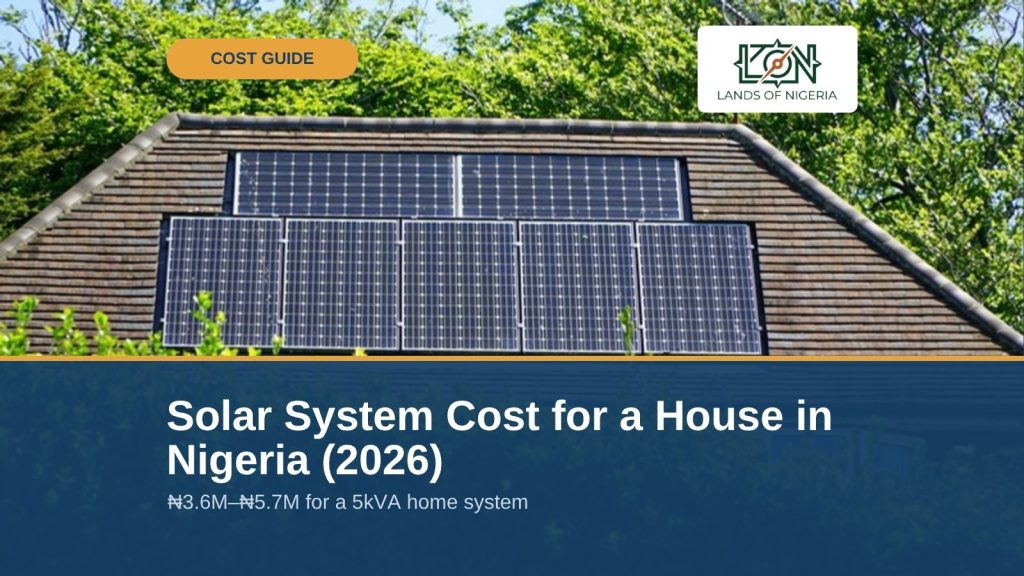

Powering a typical Nigerian 3-bedroom home with solar costs about ₦3.6 million–₦5.7 million (~$2,600–$4,120) for a complete 5kVA hybrid system in September 2026. A smaller 3kVA system for a flat runs ₦2.3M–₦3.4M (~$1,660–$2,450), and a 10kVA system for a large home or small office ₦7.9M–₦12.3M (~$5,700–$8,880). The battery is usually the single biggest cost, and the choice between lithium and tubular decides what you’ll spend over ten years. (Lagos prices, September 2026; dollar figures at ₦1,385/$, the parallel-market rate on 25 September 2026.)
“How much is solar?” has no single answer in Nigeria, because the price depends on two things: how much power you actually use, and how long you want it to run after dark. Below is what each size costs today, where the money goes, and the one decision most installer quotes rush past.
What does a full solar system cost in Nigeria in 2026?
Complete hybrid systems (panels, inverter, battery, mounting, cabling and installation) sit in these published September 2026 ranges for Lagos. Two companies can both quote a “5kVA system” at very different prices, so always ask for an itemised quote.
| System size | What it realistically powers | Typical price (₦) | ~ USD |
|---|---|---|---|
| 3kVA hybrid | Lights, fans, TV, laptops, a fridge, in a flat or small home | ₦2,300,000–₦3,400,000 | ~$1,660–$2,450 |
| 5kVA hybrid | Most of a 3-bedroom home, plus an inverter AC used carefully | ₦3,600,000–₦5,700,000 | ~$2,600–$4,120 |
| 10kVA hybrid | A large home with several ACs, or a small office | ₦7,900,000–₦12,300,000 | ~$5,700–$8,880 |
A typical 3-bedroom flat needs a 3.5kVA–5kVA system, usually with 6–10 panels of 550W each. Smaller “backup” kits for lights and phones exist, but their prices and quality vary so widely that we don’t quote a range for them.
Where does the money actually go?
| Component | Typical price, Sept 2026 (₦) | ~ USD |
|---|---|---|
| 550W monocrystalline panel (each) | ₦115,000–₦165,000 | ~$83–$119 |
| 5kVA hybrid inverter (unit only) | ₦350,000–₦650,000 | ~$253–$469 |
| 5kWh lithium (LiFePO4) battery | ₦995,000–₦2,148,000 | ~$718–$1,551 |
| 200Ah tubular (lead-acid) battery | from ₦155,000 | from ~$112 |
Watch out: a “550W” panel selling for around ₦60,000 is very likely not what it claims, and cheap online “1000W kits” rarely include 1,000 watts of panels. Buy from a supplier with a physical office and a written warranty.
Worth knowing: over 95% of solar panels sold in Nigeria are imported, so prices move with the naira. A weaker naira shows up in quotes within weeks. Lock your quote and pay promptly.
What most solar quotes leave out
The battery is the part that wears out, and it’s the most expensive to replace. Lithium (LiFePO4) batteries cost two to three times more than tubular batteries upfront, but installers report they last three to four times longer. So the cheaper tubular set that makes a quote look attractive often means buying batteries again within a few years.
That trade-off is the most important decision in the whole project. If you’ll run the system every day, lithium usually costs less over ten years even though the first cheque is bigger.
Two more things quotes skip: sizing and surge. Ask the installer to size the system from your actual appliance list and the hours you need power at night, not a round “5kVA for a 3-bedroom” guess. A simple rule of thumb: add up the watts you run at the same time and double it for start-up surge, so an 800W essentials load needs an inverter of at least 1,600VA. And insist on a pure sine wave inverter if you’ll run fridges or ACs.
Costing a full build, not just the solar? Our Feasibility Studio will pull land, construction and power costs into one honest project estimate, in naira and dollars.
Is solar cheaper than a generator in Nigeria?
Over a few years, usually yes. With petrol at around ₦1,150 a litre in Lagos (July 2026), a generator using 1.5 litres an hour for six hours a night burns about ₦310,500 (~$224) a month in fuel alone, before servicing. A correctly sized hybrid system removes most of that. Your own payback depends on your load and how many hours you run a generator today. For estates that already promise steady power, weigh it against your service charge; see our list of Lagos estates with near 24/7 power.
Frequently asked questions
How much solar do I need for a 3-bedroom flat in Nigeria?
Usually a 3.5kVA–5kVA system with 6–10 panels of 550W. A complete 5kVA hybrid system costs about ₦3.6M–₦5.7M (~$2,600–$4,120) in Lagos in September 2026.
Can solar run an air conditioner?
Yes, but ACs are power-hungry. One inverter AC used carefully is manageable on a well-sized 5kVA system; several ACs running all day point to a 10kVA system at ₦7.9M–₦12.3M (~$5,700–$8,880).
How much is a 550W solar panel in Nigeria?
About ₦115,000–₦165,000 (~$83–$119) in Lagos in September 2026, with Tier-1 brands at the top of the range.
Lithium or tubular battery?
Lithium costs two to three times more upfront but lasts three to four times longer, so for daily use it is usually cheaper over time. A 5kWh lithium battery costs ₦995,000–₦2,148,000 (~$718–$1,551).
Why do solar prices keep changing?
Because almost all the hardware is imported and priced against the dollar. When the naira moves, quotes follow within weeks.
Methodology & sources. Prices are September 2026 Lagos market ranges from PVPro’s September 2026 solar price tracker, which compiles published Nigerian retailer and installer price guides; fuel cost from the same source (July 2026 petrol price). These are market estimates, not quotes. Dollar figures at ₦1,385/$, the parallel-market rate reported on 25 September 2026. Last updated: 28 September 2026. Next review: December 2026. Journalists and researchers may cite this with attribution to LandsofNigeria.com.
Related reading: the cost to wire a house, Lagos areas with the most reliable electricity, and our construction cost tracker.

