
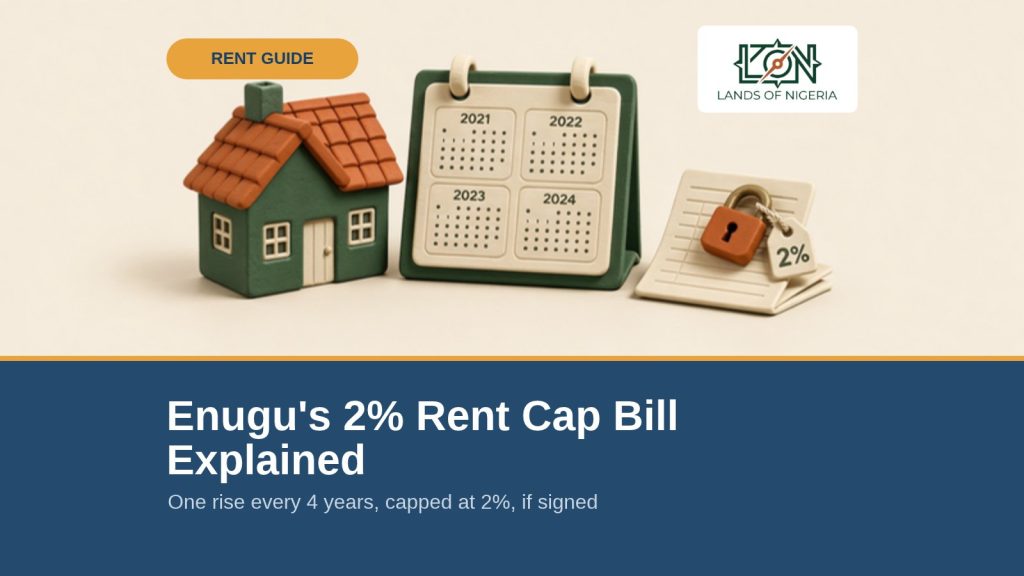

If you rent in Enugu, the rules may be about to change in your favour. On 17 November 2026, the Enugu State House of Assembly passed a bill that lets a landlord raise rent only once every four years, by no more than 2%, or up to 10% after a reasonable renovation. On a ₦1,000,000 (~$690) yearly rent, that’s a ₦20,000 (~$14) rise at most after four years. It is not law yet: Governor Peter Mbah still has to sign it. (Figures at ₦1,455/$, November 2026.)
Rent hikes have been one of the loudest complaints in Enugu this year, with lawmakers citing reports of rents jumping by more than 500% in some areas affected by the state’s land verification and recertification exercise. This bill is the Assembly’s answer. Here’s what passed, what’s still unknown, and what to do while you wait for the governor.
What did the Enugu Assembly pass?
The bill amends Enugu’s existing Landlord and Tenant Law (Cap 101, Revised Laws of Enugu State 2024) and is listed as House Bill No. 3, 2025. It had its second reading on 11 March 2026, a public hearing on 26 March, and passed third reading on 17 November (BusinessDay; Channels Television, 17 November 2026).
| Provision | What the bill says (as reported) | Example on ₦1,000,000 (~$690) rent |
|---|---|---|
| First four years of a tenancy | No rent increase allowed | Stays ₦1,000,000 (~$690) |
| Later increases | Capped at 2% of the current rent | Up to ₦1,020,000 (~$701) |
| After reasonable renovation | Up to 10% | Up to ₦1,100,000 (~$756) |
| Agency and legal fees | Regulated; figures not yet published | Unknown |
| Eviction | Stronger protection against unlawful eviction and “indiscriminate charges” | — |
The ₦1,000,000 rent is an example to show the arithmetic, not an Enugu market average.
Committee chairman Okey Mbah, who represents Nkanu East, said the bill followed wide consultation and would cut “over 60 per cent of what residents used to pay while trying to secure accommodation.” Speaker Uche Ugwu said it responds to complaints about arbitrary rent hikes, high agency and legal fees, and unlawful eviction.

Not in force yet. As of 25 November 2026, we’ve found no report that Governor Mbah has signed the bill. Until he does and the final text is published, the current Enugu tenancy law applies. The details above come from news reports, not the bill text, so the exact wording on fees, notice periods and penalties is still unknown.
What does it mean for tenants?
Once the law takes effect, a landlord who raises your rent within the first four years, or by more than 2% without renovating, would be breaking it. Your evidence is everything. Keep your tenancy agreement and every rent receipt, with dates, because proving what you paid and when is how you’d challenge an illegal increase.
For students and young workers renting near the University of Nigeria’s Enugu Campus and other busy parts of the city, agency and legal fees often add a big lump to the cost of moving. If the fee caps turn out to be strict, the upfront cost of moving could drop sharply, though we won’t know by how much until the text is out.

What does it mean for landlords and diaspora investors?
Treat the rent you set at the start of a tenancy as close to fixed for four years. Price the first rent carefully, and budget any renovation you might later use to justify the 10% exception. If you live abroad and own a rental in Enugu, brief whoever manages it now, so nobody rushes an increase that sours the tenancy or gets challenged later.
Developers should rerun build-to-rent numbers assuming flat rent for four years. With building costs still high (cement is ₦13,000–₦15,000 a bag in most markets, see our cement price guide), a four-year freeze changes payback periods. Our guide to the best areas to buy land in Enugu covers where rental demand is strongest.
Planning to build to rent in Enugu? Test whether the numbers still work under a four-year rent freeze before you commit.
How does Enugu compare with Abuja and Lagos?
Enugu’s bill goes further than its neighbours on rent increases. Abuja’s proposed bill focuses on capping advance rent at 12 months rather than limiting increases (see Abuja’s rent bill explained). In Lagos, the debate has centred on agency fees (see the Lagos 5% agency fee bill). A 2% cap every four years is one of the tightest rent controls proposed anywhere in Nigeria. The usual worry with tight caps is that some landlords hold back new rental supply, so watch how the final text balances that.
What to do this week
- Tenants: file your current agreement and receipts somewhere safe, with dates.
- Landlords: don’t rush an increase before assent. A hike timed to beat the law can sour a tenancy and may be challenged.
- Everyone: watch for the governor’s assent and the published text, which will settle fee caps and penalties.
- Buying in Enugu? Check the title before anything else, especially with the state’s recertification exercise under way.
Buying land or a rental property in Enugu? Run the same checks a careful lawyer would before you pay.
Frequently asked questions
Is the Enugu 2% rent cap now law?
No. The Assembly passed it on 17 November 2026, and it becomes law only after Governor Peter Mbah signs it. As of 25 November 2026, no assent has been reported.
How often can an Enugu landlord raise rent under the bill?
Once every four years, by up to 2%. On a ₦1,000,000 (~$690) rent, that’s ₦20,000 (~$14) at most. After a reasonable renovation, the cap rises to 10%, or ₦100,000 (~$69) on the same rent.
Does the bill cap agency fees in Enugu?
It regulates agency and legal fees, but the reported coverage doesn’t give the figures. Wait for the published text.
Does the bill apply to existing tenancies?
The reports don’t say how it treats tenancies that started before the law. The final text should settle this; until then, keep records of when your tenancy began.
Can a landlord evict me for refusing an illegal increase?
The bill strengthens protection against unlawful eviction, but the exact procedure isn’t public yet. If you face eviction, speak to a lawyer before you move out.
Sources & date stamp. Based on reporting of the Enugu State House of Assembly’s 17 November 2026 sitting by BusinessDay, Channels Television, P.M. News and Techeconomy. Example rent is illustrative. Dollar figures at ₦1,455/$ (parallel market, 24 Nov 2026). Last updated: 25 November 2026. We’ll update this page when the governor signs the bill or the final text is published. Journalists and researchers may cite this with attribution to LandsofNigeria.com.

