
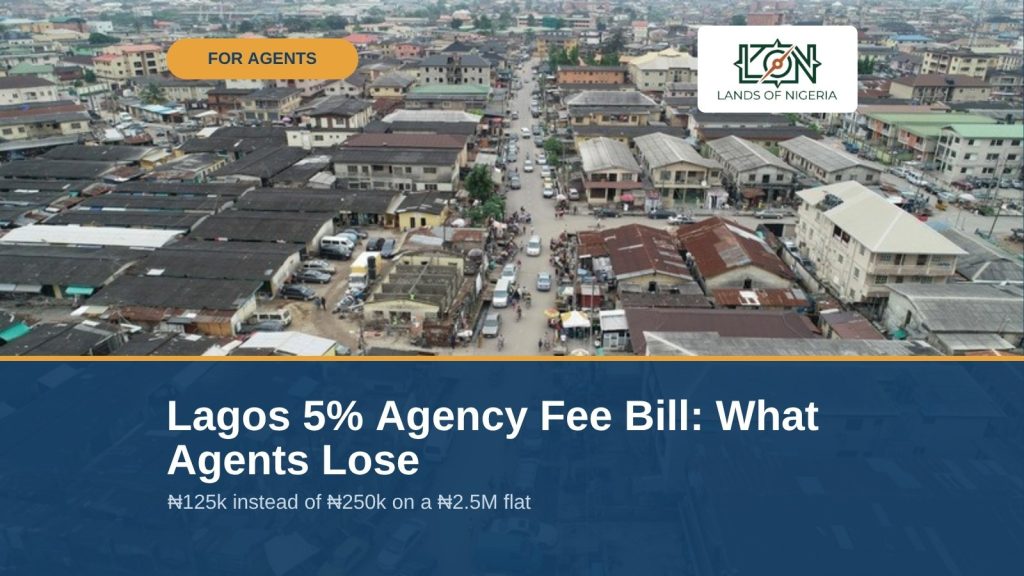

If you earn most of your money from lettings in Lagos, this bill could cut your fee on every deal in half. The proposed Lagos State Tenancy and Recovery of Premises Bill would cap agency commission at 5% of annual rent, against the usual 10%. On a ₦2.5M flat that’s ₦125,000 (~$81) instead of ₦250,000 (~$161). It also makes LASRERA registration, receipts and handing rent to the landlord within 7 working days legal duties. As of September 2026 it is still a bill, not law. (Figures at ₦1,550/$, September 2026.)
THE AI PROPERTY AGENT SERIES · PART 3 OF 6
- Start here: AI for estate agents in Nigeria
- 50 ChatGPT prompts for agents
- Set up the WhatsApp AI agent
- The Lagos 5% agency fee bill (you are here)
- 12 WhatsApp scripts that book inspections
- Protect your commission
- Facebook and Instagram ads on a small budget
Free guides for Nigerian estate agents. Send AGENT on WhatsApp to get the free chapter of our agent guide when it’s released.
Most coverage of this bill is written for tenants, and fairly so. (If you’re renting, read our tenant’s guide to the Lagos tenancy bill.) This page is for the other side of the table: the agents whose income it changes. We’ll cover what the bill says about agents, where it actually stands, the real numbers, and what a sensible agent does before it passes.
What does the bill say about agents?
According to detailed reporting on the bill by Within Nigeria, these are the provisions that affect agents directly:
| Provision | What it means for you |
|---|---|
| Commission capped at 5% of annual rent | Half the customary 10% letting fee |
| Mandatory LASRERA registration | Practising unregistered would be an offence |
| Receipts for every transaction | Cash-with-no-paper deals become a legal risk |
| Rent collected for a landlord remitted within 7 working days | Holding tenants’ money becomes an offence |
| Ban on collecting from more than one person for the same property | Targets the “double letting” scam |
| Penalties: repayment, fines up to ₦1M, up to 2 years’ imprisonment, or both | Depending on the offence |
| Wider coverage, including Ikoyi, VI, Ikeja GRA, Apapa and business premises | High-value and commercial lettings would be covered too |
The bill also limits advance rent (up to 1 year for yearly tenants, 3 months for monthly tenants), bans self-help evictions and lets tenants challenge unreasonable rent increases in court. Those mostly affect landlords and tenants, but you’ll be the one explaining them to clients.
Is the 5% cap law yet?
No. As of September 2026 it is a bill still going through the Lagos State House of Assembly. Until it is passed, signed and commenced, the 5% figure is a proposal, not a rule you or your clients can enforce.
| Date | Stage |
|---|---|
| 10 July 2025 | Second reading in the Lagos State House of Assembly |
| August 2025 | Public hearing |
| 26 May 2026 | State government still describes it as at committee stage |
| 10 July 2026 | Rent and agency-fee details discussed publicly again |
| September 2026 | Still a bill; not yet enacted |
Worth knowing: according to Ownkey, earlier attempts to cap Lagos agent fees at 5%, in 2015 and 2022, were widely ignored. The difference this time is enforcement machinery: LASRERA recovered ₦270 million from fraudulent operators in 2025–26 and has been sealing unregistered offices. Assume it will be enforced this time, even if unevenly.
How much would a letting agent lose?
Here’s the commission on one letting at today’s customary 10% versus the proposed 5%. The rents are illustrative Lagos figures; the Ikosi-Ketu flat is a real listing.
| Annual rent | At 10% (₦) | At 5% (₦) | Lost per deal |
|---|---|---|---|
| ₦1,500,000 (mini flat, mainland) | 150,000 (~$97) | 75,000 (~$48) | ₦75,000 (~$48) |
| ₦2,500,000 (2-bed, mainland) | 250,000 (~$161) | 125,000 (~$81) | ₦125,000 (~$81) |
| ₦3,800,000 (renovated 3-bed, Ikosi-Ketu) | 380,000 (~$245) | 190,000 (~$123) | ₦190,000 (~$123) |
| ₦6,000,000 (3-bed, Lekki side) | 600,000 (~$387) | 300,000 (~$194) | ₦300,000 (~$194) |
| ₦15,000,000 (Island, premium) | 1,500,000 (~$968) | 750,000 (~$484) | ₦750,000 (~$484) |
The volume maths is the real story. An agent who wants ₦6M a year from ₦2.5M lettings needs 24 deals at 10%, or 48 deals at 5%. Double the deals means double the enquiries answered, inspections run and paperwork done, with the same hours in the day.
Worth knowing: the cap in the bill is on agency commission on tenancies. Sales commission, customarily 5–10% of the price and paid by the seller, isn’t the target of these provisions. The separate “legal” or “agreement” fee is a lawyer’s charge, not the agent’s. Relabelling your own fee as “legal” to get around a cap is exactly the practice regulators are going after.
What should agents do now?
1. Register with LASRERA, if you haven’t
Under the bill, practising without registration becomes an offence. It is also the fastest trust signal you have: clients can verify a registered agent themselves. When unregistered operators are pushed out, registered agents inherit their clients.
2. Start the paperwork habits the bill will require
Issue a receipt for every payment. Pass landlords’ money on within 7 working days. Never take money from two people for the same property. These cost you nothing now, and they’re also your evidence if a commission is ever disputed. Nigeria’s Supreme Court has held that an agent must show they were the effective cause of a deal, not merely that they introduced the client.
3. Get paid by landlords, not just tenants
Property management fees paid by the landlord, for finding tenants, collecting rent and handling maintenance, are a separate, ongoing income line. They matter most for absentee and diaspora landlords, who will pay for someone reliable. One managed building can be worth more over a year than several one-off lettings.
4. Cut the time each deal takes
If you’ll need twice the deals, each deal has to cost you less time. This is where AI earns its keep: an AI agent on WhatsApp Business that answers routine enquiries and books inspections, and copy-paste prompts for listings, follow-ups and deal records.
5. Put your fees in writing, upfront
Tenants are reading the same headlines you are. An agent who shows the full cost breakdown before inspection, and sticks to it, wins the client who has been burned by surprise charges elsewhere.
Built for agents working through this change. We’re preparing a practical guide for Nigerian agents: WhatsApp scripts, trust templates, a record-keeping system and AI workflows that cut the time per deal. Send AGENT on WhatsApp to get the free chapter when it’s released.
Frequently asked questions
Is the 5% agency fee in Lagos law now?
No. As of September 2026 it is part of the Lagos State Tenancy and Recovery of Premises Bill, still going through the House of Assembly. It becomes binding only after it is passed, signed and commenced.
How much would an agent earn on a ₦2.5M rental under the bill?
₦125,000 (~$81) at 5%, compared with ₦250,000 (~$161) at the customary 10%. On a ₦3.8M rental, it’s ₦190,000 (~$123) instead of ₦380,000 (~$245).
Does the cap apply to property sales?
The cap in the bill concerns commission on tenancies. Sales commission, customarily 5–10% paid by the seller, is negotiated separately. Check the final text once the law is passed.
What are the penalties for agents under the bill?
Depending on the offence, repayment of money, a fine of up to ₦1 million, imprisonment of up to two years, or both. Offences include operating unregistered, collecting from more than one person for a property, failing to issue receipts and withholding landlords’ money.
Does it cover Ikoyi, VI and Lekki?
Reports say the bill would extend tenancy rules to areas like Ikoyi, Victoria Island, Ikeja GRA and Apapa, which were treated differently before, and to business premises such as shops and offices, subject to listed exemptions.
Part of our guide to AI for real estate agents in Nigeria.
Method and date: bill provisions and timeline from Within Nigeria’s 9 September 2026 report and Prestige Real Estate News (8 September 2026); earlier cap attempts from Ownkey (August 2026); enforcement figures from LASRERA as reported by Daily Times. Rents are illustrative; the Ikosi-Ketu figure is a real 2026 listing. Figures at ₦1,550/$. This is not legal advice. Last updated: 25 September 2026; we’ll update this page when the bill is passed or amended. Journalists and researchers may cite this with attribution to LandsofNigeria.com.

