

Owning a home young in Nigeria in 2026 is hard, not hopeless. The realistic routes are the National Housing Fund (NHF) mortgage at 6% interest through the Federal Mortgage Bank (ceiling now ₦85,000,000 / ~$54,800), the government’s Renewed Hope units now selling in Lagos and Abuja, cooperative and rent-to-own schemes, and buying a plot early in a satellite town for as little as ₦2,000,000–₦5,000,000 (~$1,290–$3,225) and building in stages. What kills the dream isn’t ambition — it’s the 25–30% commercial mortgage rate nobody warns you about. (Figures at ₦1,550/$, August 2026.)
This is a full 2026 rebuild of an older, vaguer guide. The old version listed “solutions” without numbers. This one gives you the real interest rates, the real entry prices, and an honest ranking of which routes actually work for a young professional on a Nigerian salary.
Why it feels impossible — and what’s actually true
Wages haven’t kept pace with property prices, and the mortgage market barely functions: a commercial-bank home loan in 2026 still carries roughly 25–30% interest, which prices out almost everyone on a salary. So most homes are still bought with cash, saved slowly. That’s the wall. The way through it isn’t a commercial mortgage — it’s the subsidised and staged routes below.
Route 1: The NHF mortgage (your cheapest money)
The National Housing Fund, run through the Federal Mortgage Bank of Nigeria (FMBN), lends at 6% interest — a fraction of commercial rates — over up to 30 years. You contribute 2.5% of your monthly income to qualify. In 2026 the maximum loan was raised to ₦85,000,000 (~$54,800), though the amount you personally qualify for depends on your income and equity contribution. It’s slow and paperwork-heavy, but at 6% versus 27%, it’s the single biggest lever a young buyer has.
Route 2: Renewed Hope units
The federal government’s Renewed Hope programme is delivering subsidised homes, with 2,000+ units in Lagos nearing completion, a 2,000-unit Renewed Hope City in Ibeju-Lekki already taking sales, and a national plan for 77,400 social housing units plus new cities in Lagos, Abuja and Kano, per the Guardian. Many are sold on mortgage or instalment terms. Treat allocation claims with care and apply only through official channels — but for an entry-level buyer, this is a real, subsidised option worth tracking.
Route 3: Cooperatives and rent-to-own
Housing cooperatives let members pool funds to buy land and build at scale, cutting the per-person cost and unlocking group discounts on materials. Rent-to-own schemes let you occupy a home while payments count toward ownership. Both spread the burden — just read the contract with your own lawyer, because the weak ones bury unfavourable exit terms in the fine print.
Route 4: Buy a plot early, build in stages
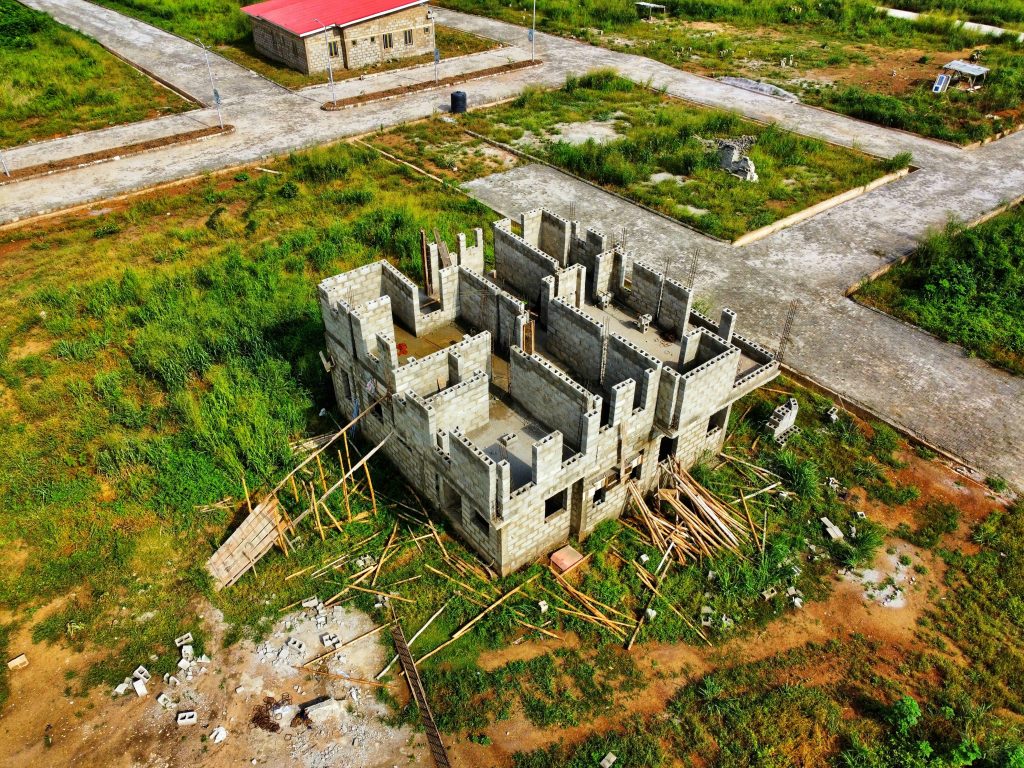
The oldest affordable path in Nigeria: buy land young in a growth corridor, then build room by room as funds allow. In satellite towns along the Lagos–Ogun axis (Mowe, Ibafo, Simawa) and the outskirts of Ibadan and Abuja, plots can still start around ₦3,000,000 (~,935) for 300 sqm in Mowe, though listing averages there sit nearer ₦7M–₦9M. Staged building beats renting forever — but only if the title is clean, which on the cheap urban fringe is exactly where it’s most often not.
| Route | Rough cost of entry | Best for |
|---|---|---|
| NHF mortgage (6%) | 2.5% income contribution; equity 10–30% | Salaried workers who can document income |
| Renewed Hope unit | FMBN rent-to-own at 7% over up to 30 years, or an NHF mortgage at 6% | First-time, lower-income buyers |
| Cooperative / rent-to-own | Monthly contributions | Those without a lump sum |
| Plot + staged build | ₦2M–₦5M (~$1,290–$3,225) for land | Patient buyers with time on their side |
Weighing a mortgage against building in stages? The Feasibility Studio runs both paths on real 2026 costs — land, materials, interest — so you can see which one actually gets you a home faster, in naira and dollars.
What most “affordable homeownership” guides leave out
Two hard truths. First, the cheap plot is where the title risk lives. The far-fringe land that fits a young budget is disproportionately un-excised, community-owned, or double-sold — so the money you save on price you can lose entirely on a bad title. Verify before you celebrate the bargain. Second, off-plan and instalment plans transfer risk to you. Paying a developer over 12–36 months for a home that isn’t built yet means your money is exposed if the developer stalls or folds. Buy off-plan only from developers with a finished track record, and insist on terms that protect you if delivery slips. The government itself is moving toward developer licensing and escrow for exactly this reason.
Watch out: “Own a home for ₦500k down!” adverts targeting young professionals are a common funnel for estates with no approval or title. A low deposit is not the same as a safe purchase. Run every offer through the same verification you’d give a ₦50 million plot.
Frequently asked questions
What is the cheapest way to own a home in Nigeria as a young person?
For most salaried buyers, the NHF mortgage at 6% is the cheapest financing. For those without steady documented income, buying a small plot in a growth corridor (from about ₦2M / ~$1,290) and building in stages is the most common self-funded route.
Can I get a mortgage in Nigeria on a normal salary?
A commercial-bank mortgage at 25–30% is out of reach for most salaries. The realistic option is the subsidised NHF scheme at 6%, or a state/Renewed Hope housing programme — not a regular bank loan.
Are Renewed Hope homes real and available?
Yes — thousands of units are completed or under construction in Lagos, Abuja and beyond in 2026, with some already selling. Apply only through official channels and verify any allocation before paying.
Is buying land on the outskirts safe?
It can be, but the urban fringe carries the highest title risk in Nigeria. Cheap land is only a bargain once an independent search confirms clean, approved title. Never skip verification to chase a low price.
Methodology & sources: Interest rates, NHF terms and the ₦85M ceiling from FMBN/NHF reporting via Nairametrics; Renewed Hope figures from the Guardian (August 2026). Land prices are indicative satellite-town ranges and vary sharply by exact location — verify locally. Dollar figures at ₦1,550/$ (site planning rate; the naira traded near ₦1,364/$ officially in early August 2026). Last updated: August 7, 2026. Next review: February 2027. Journalists and researchers may cite this with attribution to LandsofNigeria.com.
Related guides: FMBN Raises the Mortgage Ceiling to ₦85M (2026) · Renting vs Buying in Lagos (2026) · Where to Buy Land in Lagos by Budget · Cost of Building a 3-Bedroom Bungalow (2026)

