
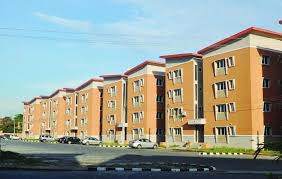

If you’re building rental income rather than a family home, the maths changes. A standard block of four 2-bedroom flats costs roughly ₦35,000,000–₦65,000,000 (~$22,600–$41,900) to build in Nigeria in 2026, excluding land — about ₦8.75M–₦16.25M (~$5,650–$10,500) per unit. Push to six flats and you’re looking at ₦55,000,000–₦95,000,000 (~$35,500–$61,300); go to bigger 3-bedroom units and the top end climbs past ₦90M (~$58,100). The single biggest swing factor isn’t the number of flats — it’s your finish level and your city. (Figures at ₦1,550/$, August 2026; land not included.)
Here’s the thing most “cost of building in Nigeria” guides miss: a block of flats is not just a bigger house. You share a foundation, a roof and one compound across several income-earning units, so your cost per flat drops — but you also carry things a single house never does, like a bigger septic system, more plumbing stacks, and a service area. Let’s break down what a realistic 2026 budget looks like, and where the numbers really move.
What does a block of flats cost to build in 2026?
Short answer: between about ₦35M and ₦95M (~$22,600–$61,300) for the building itself, depending on how many flats, how big each one is, and how well you finish them. The table below uses mid-market standard finishes as the baseline, with land excluded.
| Block type | Total build cost (₦) | ~ USD | Per unit (₦) |
|---|---|---|---|
| Block of 4 × 2-bedroom flats | ₦35M–₦65M | ~$22,600–$41,900 | ₦8.75M–₦16.25M |
| Block of 6 × 2-bedroom flats | ₦55M–₦95M | ~$35,500–$61,300 | ₦9.2M–₦15.8M |
| Block of 4 × 3-bedroom flats | ₦50M–₦90M | ~$32,300–$58,100 | ₦12.5M–₦22.5M |
| Block of 8 × 2-bedroom flats (2 floors) | ₦75M–₦140M | ~$48,400–$90,300 | ₦9.4M–₦17.5M |
These are ranges, not promises. The low end assumes economy-to-standard finishes and a cheaper city; the high end assumes better finishes, a two-storey structure or a pricey Lagos plot. For a fuller set of house-by-house figures, see our complete 2026 cost of building and buying guide.
Why the cost swings so much: the per-square-metre reality
The honest way to budget a block of flats is per square metre, then multiply by your total floor area. In 2026, standard residential construction runs about ₦150,000–₦230,000/m² in Lagos, ₦130,000–₦185,000/m² in Abuja, and ₦120,000–₦175,000/m² in cities like Ibadan, Enugu and Port Harcourt, according to current market build-cost data. Economy builds can dip toward ₦80,000/m²; luxury finishes push past ₦400,000/m².
| City | Standard build (₦/m²) | ~ USD/m² |
|---|---|---|
| Lagos | ₦150,000–₦230,000 | ~$97–$148 |
| Abuja | ₦130,000–₦185,000 | ~$84–$119 |
| Ibadan / Enugu / Port Harcourt | ₦120,000–₦175,000 | ~$77–$113 |
A block of four 2-bedroom flats is typically 250–320 m² of built area. At ₦180,000/m² that’s roughly ₦45M–₦58M — which is why our headline range lands where it does. Lagos is usually 15–25% pricier than other cities for the same drawing.
Worth knowing: the number that moved most between 2024 and 2026 is cement. A 50kg bag went from about ₦7,500 in late 2024 to roughly ₦12,000–₦15,000 by mid-2026. On a block of flats — which can swallow 500–900 bags — that single line item alone can add ₦3M–₦5M to your budget. Track it in our 2026 cement price guide.
Where the money actually goes (stage by stage)
For a standard block of four 2-bedroom flats, here’s roughly how a ₦50M build splits across stages. Percentages hold fairly well across sizes; the naira totals scale with your design.
| Stage | Share of budget | Typical cost (₦) | ~ USD |
|---|---|---|---|
| Foundation & substructure | 12–18% | ₦6M–₦9M | ~$3,900–$5,800 |
| Blockwork & frame (columns, beams, slab) | 20–28% | ₦10M–₦14M | ~$6,450–$9,000 |
| Roofing | 8–12% | ₦4M–₦6M | ~$2,600–$3,900 |
| Plumbing, soakaway & septic (all units) | 8–12% | ₦4M–₦6M | ~$2,600–$3,900 |
| Electrical wiring (all units) | 6–10% | ₦3M–₦5M | ~$1,900–$3,200 |
| Plastering, screeding & finishes | 25–35% | ₦12M–₦18M | ~$7,700–$11,600 |
Finishing is where budgets live or die — tiles, doors, kitchens, painting and POP swing the total more than the structure does. If you want to sanity-check individual trades, we have detailed 2026 breakdowns for plastering and the cost of a single 3-bedroom flat.
Working out whether a block of flats actually pays? Our Feasibility Studio models build cost, rental income and net yield side by side on real Nigerian figures — so you know your payback before you pour a foundation.
Launching soon — join the founding list →
What most block-of-flats estimates leave out
This is where builders get ambushed. The structure is the easy part. The costs that blow budgets are the ones nobody quotes upfront:
- Land and its fees. Every figure here excludes the plot. On top of the land price you’ll pay survey, legal, and title/perfection costs — often 10–20% of the land value in Lagos after the 2026 valuation changes.
- Shared services. A block of flats needs a bigger septic system, a borehole and overhead tank, an external water network, and often a generator house or solar setup. A borehole alone runs ₦900,000–₦3.5M in 2026.
- Compound works. Fencing, a gate, interlocking or a concrete drive, drainage and a parking apron can add ₦3M–₦8M that rarely appears in a per-square-metre quote.
- Approvals and professionals. Building plan approval, a registered builder, an engineer and site supervision are not optional extras — they’re what stops a block of flats becoming a liability.
- Inflation during the build. Multi-unit builds take 12–24 months. If cement or rebar jumps mid-project, your budget moves with it. Build in a 10–15% contingency.
Watch out: the cheapest quote is often the most expensive build. Nigeria’s building regulators spent 2026 warning against unqualified “quack” builders behind recurring collapses. Skimping on an engineer to save a few hundred thousand naira can cost you the whole structure — and lives. Verify your builder is qualified before you hand over a kobo.
Is a block of flats a good investment in 2026?
It can be — that’s why so many diaspora buyers choose it. Gross rental yields on Nigerian residential property run about 4–8% in 2026, and a well-located block of small flats often earns more per naira than one large house because rent-per-square-metre is higher on smaller units. But run the numbers net, not gross: after management, vacancy and maintenance, real returns are usually 2–4 points lower. Our guide to rental yields by city shows where the maths works best.
Frequently asked questions
How much does it cost to build a block of 4 flats in Nigeria in 2026?
About ₦35M–₦65M (~$22,600–$41,900) for four 2-bedroom flats with standard finishes, excluding land. That’s roughly ₦8.75M–₦16.25M per unit. Lagos sits at the top of the range; Ibadan, Enugu and Port Harcourt at the lower end.
How much to build 6 flats in Nigeria?
Roughly ₦55M–₦95M (~$35,500–$61,300) for six 2-bedroom units with standard finishes, land excluded. Going to a two-storey layout to fit more units on a small plot pushes cost up but improves land efficiency.
Does the cost include the land?
No. Every figure here is build-only. Land varies enormously — from a few million naira in an outer suburb to ₦50M+ for a plot in a prime Lagos or Abuja area — plus survey, legal and title-perfection fees on top.
What’s the cheapest way to build a block of flats?
Build in a lower-cost city, keep the floor plan compact and repetitive (identical units share formwork and plumbing), buy materials in bulk at the right time, and use a qualified builder to avoid costly rework. Cutting the professional to save money is the most expensive “saving” there is.
Methodology & sources: build-cost ranges reflect 2026 per-square-metre rates and multi-unit quotes from active Nigerian builders and cost trackers, cross-referenced with Nairametrics’ 2026 market outlook. Six- and eight-flat figures are scaled from the same per-unit cost base and are indicative estimates, not fixed quotes. Dollar figures at ₦1,550/$ (site planning rate; the naira traded near ₦1,350–1,400/$ officially in August 2026). All figures exclude land. Last updated: August 2026. Next review: February 2027. Journalists and researchers may cite this with attribution to LandsofNigeria.com.
Before you commit millions to a build, cost it properly. The Feasibility Studio turns your plot, unit count and finish level into a clear build budget and projected yield.
Launching soon — join the founding list →
Related guides: Cost of Building & Buying in Nigeria (2026) · Cost of Building a 2-Bedroom Bungalow · Costliest Mistakes First-Time Land Buyers Make

